
Redgum Village Renovation Update
Redgum Village has had a massive upgrade
Over the last 6 months Redgum has en-suited every room to keep up with expectations for mine camp style accommodation.
The kitchen also has more modern appliances including a new combie oven (this certainly made our cook very happy)

Added store room with added walk-in freezer, with two we can keep all meat separate to other frozen items.
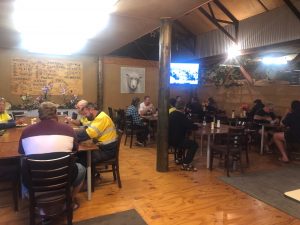
The serving area has been re arranged and all dining is in the 40 seat area where we tried out the Redgum Restaurant.
Dandaragan does not need a Restaurant so is now a lovely country barn theme Dining area for all onsite guests.
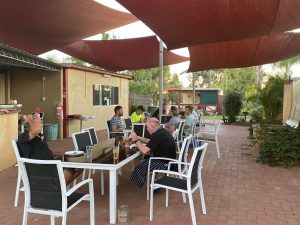
Many veranda’s have been upgraded and social gathering areas added to keep gatherings smaller and more of them
Around 200 trees and shrubs have been planted, more blue metal on driveways and parking, more truck parking areas and up the back a big clean up, tidy up, re skin of buildings, tree line on boundary, vertical garden in between buildings, clothes line area and chill out area to soak up the setting sun 🙂
Let the pics do the talking ….


Dandaragan’s Changing Landscape
The landscape around Dandaragan is changing daily with wind towers popping up and large walls of yellow sand dominating the skyline and road verges within the triangle of Cataby Regan’s ford and Dandaragan. Even slightly further south near Wannamal Rd there is a humongous pile of sand that virtually appeared overnight next to the other long yellow sand stretch of their new mineral sands mine.
Is this good or bad for Dandaragan? The environment? Tourism? Local business etc.. well that all depends on who you are and what you do for a living.
Personally its happy days for Redgum as we have battled to keep the Village open over the 20 years of existence. Even more so since 2010 when we departed our ways from the shearing industry.
If we didn’t think Iluka mineral sands and The Yandin windfarm were going to ever eventuate we may have pulled the plug many years ago.

Mind you once the go ahead for both those projects got the green light it wasn’t exactly crimson and roses. When Iluka had the option to use the old Tronox camp while they built the new camps good ole Redgum was simply left completely out of the picture.
Many sleepless nights of why and what the f.. is happening here why isn’t local business being supported rah rah rah. Eventually we just got over it and looked for other opportunities and sure enough they presented themselves.
The windfarm contractors, sub-contractors and other workers did use our facilities early on then they too found other options. Ones that included houses, beaches, pubs with restaurants and a bit of extra travel. Can’t knock that as the towns enjoyed the extra business and if I had a choice of travelling from Lancelin by the beach or staying in Dandaragan at a working persons camp …..
Then again if you cook my food and it’s a 5min drive to work ….
Comes down to company costings and in some cases personal preference. It’s quite cheap to put 4 guys in a house and give them a food and travel allowance per day. Plus 30 to 40 mins travel isn’t overboard these days.

The many thousands of dollars upgrading the older rooms of Redgum to en-suite started to appeal to some companies and so far this year we have been quite busy.
Funny enough Redgum is allowed to have 99 people on site and with communal rooms we could do this. Now as we have virtually eliminated all shared rooms, we have decreased our capacity to our actual room numbers of 62. And honestly, that is enough.
Also, with current govt social distance guidelines in place, one person per room gives them plenty social separation. Even the outdoor entertaining areas are spread out with limited seating. More places to chill out but less seating per area. A reduction in total persons on site at Redgum has been very beneficial. I would not like to think if this pandemic was back in the day when we had 90 backpackers on site, fuuurk the powers that be would have shut us down for sure, that’s if we didn’t close voluntarily. Trying to police social distancing would’ve been a logistical nightmare.
Lots going on in Dandaragan at the moment, lots of new Roadworks too which is all very beneficial long term for the Dandaragan Shire.
Powdered Milk Dairy in Dandaragan Shire
Radical proposal to build a billion-dollar, effluent-powered dairy for baby formula market
WA Country Hour
By Joanna Prendergast
Updated 9 Mar 2020,

PHOTO: A Chinese backed dairy company is hoping to build a $1 billion dairy in WA’s Mid West. (ABC Rural: Kim Honan)
Insatiable Asian demand for Australian baby formula has sparked a radical proposal from a Chinese-backed company to build a $1.2 billion, effluent-powered dairy and milk powdering plant in Western Australia.
Key points:
• A plan to build WA’s first milk powdering plan has been proposed by Chinese-backed company WADE
• The company says it intends to operate exclusively as an exporter, but local producers have concerns about the potential impact on the domestic market
• If approved, the plant would be fully operational by 2024 and would create as many as 480 ongoing jobs, the company says
WA Dairy and Energy (WADE) plans to build a 24,000 head free stall dairy south of Badgingarra, in the state’s Mid West region, which would produce 30,000 tonnes of powdered milk per annum.
WADE CEO Ian Thubron said due to the project’s large water requirements for feed production, and the depth of the aquifer at Badgingarra, a self-sufficient and cheaper source of power was needed — effluent.
“Effectively, a pure dairy business becomes a dairy energy and cropping business,” he said.
Mr Thubron said a definitive feasibility study was yet to be completed, but a positive pre-feasibility study on the $1.2b project had spurred WADE and its backer, Tsing Capital Australia, to push forward with the plan.
Baby formula target market
Mr Thubron said the milk produced at the operation would be processed into formula onsite and exported to Asian markets.
He did not view the project as potential competition to the domestic-focussed WA dairy industry.
“Essentially we will receive the milk, we will process it into the branded infant milk product, and that will then be exported through one of the ports or airports available to us,” Mr Thubron said.
“We are looking at producing all of our product for export.
“So, whilst our primary production point might be slightly higher, we add value through processing and branding for export.”

Concerns for domestic producers South West dairy consultant Steve Hossen said service providers to the contracting WA dairy industry would benefit from such a large dairy enterprise, but he said it posed a risk to any price hikes the existing dairy industry may benefit from.
“We’ve got predominately a domestic market, and that market runs up when milk is short in the state,” he said.
“If that market runs up, and the price goes up … think of yourself as a processor sourcing milk more expensive than this supplier who is 250 kilometres out of Perth, that milk at times will make its way into the domestic market.
“We need to have those runs up in price to help cover the difficult phases we get.

PHOTO: Asian demand for Australian made infant formula is expected to remain strong. (ABC Rural: Joshua Becker)
Water licence essential
WADE has the option to purchase two properties near Badgingarra and is currently drilling for water in the area after being granted a 26D licence from the WA State Government.
Mr Thubron said a large volume of water was needed for the project, and a successful application for groundwater access was crucial for the project to go ahead.
“The Yarragadee sub-aquifer is not taken at the moment because the water is too deep to be economically viable to take,” he said.
“We are looking at somewhere over 10 gigalitres, but that will have to be determined based on what the hydro-geological report.”
Water licences in WA are assessed under the Rights in Water and Irrigation Act 1914, which operates on a first in, first served basis.
PHOTO: Dairy cattle would live in free stall barns under a proposal by WA Dairy and Energy at Badgingarra in WA. (ABC Rural: Kim Honan)
Hundreds of ongoing jobs
Mr Thubron said WADE had identified Badgingarra as a suitable location for the venture following a 2012 State Government report into building the dairy industry.
“The reason they determined the Mid West was because of the climate being suitable for the cows, the availability of water, the Brand Highway, the Bunbury Dampier gas pipeline, high-voltage power and so on,” he said.
If the project goes ahead, Mr Thubron said it would create 480 ongoing jobs, and 950 construction jobs.
The next steps include community consultation and a definitive feasibility study, but Mr Thubron hoped earth could be turning on the site as soon as the end of the year.
“It is a very long-term project,” he said.
“You can’t suddenly create a herd of 20,000 cows and barns and start producing, so the whole thing will be phased over a three to four year period.
“We will have phases the will come online during the course of the project, so by the time we get to 2024 when we’ve completed it, we will have started producing over that period of time.
PHOTO: Badgingarra is typically a sheep and broadacre farming area. (ABC News: Jessica Hayes)
Free stall dairy model
The project plans to have 20,000 head of cattle milking by 2024 using a free stall system.
“Our cows are born and grow up in paddocks, at about two years they come into the free stall barn,” Mr Thubron said.
“Within the barn they have access to food, water, shelter and bedding, and outside the barn they have access to the irrigated pivot areas.
Mr Thubron said WADE’s animal welfare policy had received feedback and recommendations from the RSPCA.
WA Biggest Feedlot in Moora Dandaragan Shire
Andrew ‘Twiggy’ Forrest to build WA’s biggest cattle feedlot
Canberra Times, February 17 2020 Aidan Smith
MILLIONS of dollars will be poured into road upgrades and drainage infrastructure prior to the building of the biggest cattle feedlot in Western Australia.

Andrew Forrest at Harvey Beef. Credit: Ian Munro/The West Australian
Harvest Road, part of Andrew Forrest’s Minderoo Group, has won approval from the State government’s Mid West Wheatbelt Joint Development Assessment Panel, which oversaw the application proposal by the Harvest Road Group to build a $51.9 million feedlot at its recently-acquired Koojan Downs property near Moora.
The property, which totals more than 7000 hectares over four lots, straddles the shires of Dandaragan, Moora and Victoria Plains.
Farm Weekly reported last year that Mr Forrest purchased Koojan Downs for about $5.5m, before acquiring neighbouring farms Avena Vale (1251ha), Damper Downs (1486ha) and Water Hill (1494ha) for a further $5m.
The Koojan Downs feedlot facility will be on 3751ha and would be designed to supply 60,000, 100-day grain finished cattle each year to Harvest Road’s processing facility Harvey Beef.
Harvest Road chief executive Greg Harvey said they were “pleased to have obtained development approval from the State government’s Mid West Wheatbelt Joint Development Assessment Panel for the Koojan Downs project, achieving a key milestone in the approvals process”.
“A number of additional local and State government approvals are required before construction can commence,” Mr Harvey said.
“Harvest Road Group aims to begin construction in March, following the receipt of remaining approvals and the award of construction tenders.
“One of the key strategic reasons behind the development of the Koojan project is the desire to fill a long-standing gap in the Western Australian cattle supply chain.
“The project is designed to help build resilience in the industry, which is more reliant on the live export market than east coast beef industries, by offering WA cattle farmers reliable, year-round WA-based demand.
“This will create value for the State by keeping more of the beef value chain onshore, increasing local jobs and the value of the product that is exported.
“The Harvey Beef plant will be expanded, resulting in an increase in both shifts and jobs.”
According to the assessment panel’s minutes the feedlot’s construction was supported because it aligned with the strategic objectives of the shires for jobs growth and economic development in the region, as well as meeting environmental conditions.
It was highlighted by Main Roads and the local shires that significant upgrades to road infrastructure would need to be undertaken to cater for the “average daily traffic increase of 263 vehicles” along the Bindoon Moora Road and Koojan West Road.
It is anticipated that 235 truck movements a week would occur on the roads for incoming cattle, feed, oil and supplement requirements, while 63 movements a week would occur for outgoing cattle to Harvey Beef for processing.
Light vehicle movements a week would number about 687.
According to the proposal the development “will be constructed in two 20,000 head of cattle stages, resulting in a 40,000 head capacity at a stocking rate of 18m2 per head”.
“Each stage will have associated feed delivery roads, cattle laneways, cattle handling facilities and hospital pens; supported by site-wide infrastructure that includes earthworks and drainage infrastructure throughout the site; an above ground truck weighbridge and associated office at the main entry to the site off Boundary Road; a turkey’s nest (above ground dam) to supply water to the intensive feeding facility; a feed mill and grain storage facility for processing grain feed; effluent dams and sedimentation ponds to manage wastewater disposal; a manure handling and storage pad; provision for a future 2.8ha solar farm; centre pivot irrigation systems that will utilise recycled water from the sedimentation ponds and effluent dams to support animal fodder growth; supply and installation of pipe work and water pumps throughout the site, including three production bores, two which will be ‘duty’ bores powered by the site electrical supply, whilst the third bore will be a backup only and fitted with a diesel generator supply; a new staff amenity building to complement the existing workers accommodation building on site and a new horse stables building and chemical storage building,” the proposal said.
While the first development phase would accommodate 40,000 cattle at any one time, a proposed second phase would double this capacity.
Harvest Road announced the plan in December last year, which it said would “establish a world-class cattle facility to develop lines of WA premium beef for local and international markets”.
The facility would see cattle raised using nutritional feeding programs and “implement a free-range inspired model, to provide the cattle with significantly more freedom to move than the current industry standard”.
Innovative cattle husbandry practices, as advised by world expert professor Temple Grandin, are proposed to deliver a radical improvement in animal welfare.
Harvest Road said the Koojan facility would be the most “innovative, cost efficient and high-quality cattle operation in WA”.
“It would fill a long-standing gap in the WA cattle supply chain and provide a viable and sustainable alternative to live export markets for local cattle producers,” Harvest Road said.
“It would also complement and advance WA’s existing feeding facilities.”
Mr Harvey said “WA by rights should be producing the highest quality beef in Asia”.
“We have a unique provenance as one of the most isolated and pristine agricultural regions in the world and WA needs to capitalise on that,” he said.
“Today’s food consumers are food citizens.
“They express their right to have ethically-produced foods that are clean and traceable.
“This project will build an international reputation for Western Australian beef that delivers a high-quality product to consumers with confidence.”
The Koojan facility would also provide local producers with year-round options to sell their cattle, as well as provide a premium and super premium market for WA cattle producers, including the development of 100-day, Angus and Wagyu lines.
Cataby Busy with Wind Farms and Mining
Fun and games in and around Cataby and Dandaragan township within the Dandaragan shire at the moment.
Yandin wind farm, 5km from Redgum Village in Dandaragan seems to be tracking along at the same time Iluka mine seems to be gathering momentum and throw in some major roadworks just to add a bit of flavour.
Certainly a boom patch for Cataby and the surrounding region.
 Great to see Moora getting there fear share of the accommodation for the mountain of workers required for these projects.
One can only wonder what would be if Dandaragan had a few more shopping options.
Having said that in 12 months we might be back to quiet ole Dandaragan again, well perhaps not. When a region with-in a radius of 20km has two mineral sands mines and wind farm with another on the drawing board, they self-generate long term maintenance and other job opportunities.
They also breed / attract other sub industries to the area, which we are seeing here already.
There are more than just miners and wind farm contractors seeking accommodation at this time.
Would be great if the left hand spoke to the right hand and the powers that be could spread the work load… yeah right and we all know it doesn’t work that way.
One in all in, let’s do it all now. Wouldn’t have it any other way, would we?
Crikey that would make life and business to easy and that’s a no no in this day and age. C’mon behave yourself ole fella.

Still renovations moving forward at Redgum, almost last of the original larger rooms getting their makeover and a bathroom. Add a bathroom or two and delete a shared bathroom block, or should I say re-decorate an unneeded communal bathroom block into a revamped laundry.
Redecorate the unused back of D Block communal kitchen into a gym etc..
Keeping the footprint of Redgum as original as possible and redecorating every room to 2020 expectations ( within reason and our own personal budget), Dam wouldn’t it be nice if a company said here is a couple mill, go build a new camp and any spare rooms we don’t need, go rent em out for the cost of food and wages only and we will maintain it and pay all the administration costs. Happy Days!
But if that happened, we wouldn’t have our own quirkiness ways, rules n regs, our choice of guests that suit our requirements and relaxation policy etc.. etc… la de dardy dah.
Hmmm but then again …….
Ha-ha damned if you do and damned if you don’t, we are who we are and we do the best we can with the tools we have.
Redgum Village is homely and comfortable and not owned by a multi-million dollar company.
Just us and our awesome quirky band of staff that really make Redgum what it is and we love it. Seems the majority of our guests do too. I did say majority, not all 😊
Very importantly, we do appreciate our mining guests from either mine when they are full and or a bit busy, Thankyou Iluka and Tronox because long term without you we would not be here. Its now been 20 years of existence in Dandaragan.
WooooHoooo
We thank all the wind farm subbies that are staying here and allowing us to refurbish Redgum Village while we work around you. Thankyou.
And yeah Redgum needed it 🙂
Gallery of Redgum Refurbish
The refurbish of Redgum Village continues with adding ensuites, updating rooms, making areas to relax, replacing all outside tables and chairs






Harvey Beef Cattle Feedlot Dandaragan
Harvey Beef proposes state’s biggest intensive cattle feedlot in Wheatbelt – Jan 24 2020.
The state’s largest beef processor and exporter Harvey Beef has proposed to build and operate a $51 million intensive cattle feedlot in the Wheatbelt to future-proof its supply chain against climate change, drought and diminishing pasture.
The largest cattle feedlot in the state, more than double the size of the current largest, would be in the Yathroo Region Dandaragan Shire – an hour’s drive north of Gingin and 25 kilometres southeast of Dandaragan township – to take in pasture-raised cattle and feed them enough grain to put on 200 kilograms in their final 100 days.

Angus cattle at a feedlot in Central Victoria. CREDIT: RICHARD CORNISH
The application is from owners Harvest Road Group, part of the agricultural and food production division of Andrew Forrest’s Minderoo Group which includes Harvey Beef, as well as Koojan Downs and Greg Harvey.
“This will provide greater security for cattle producers and Harvey Beef to withstand the ups and downs of the market, whilst ensuring a consistent supply of high-quality grain finished cattle for the WA domestic market and the rapidly growing premium export markets around the world,” their proposal said.
“As identified by the [state government] in 2018, much of the state has experienced climatic change over the past 50 years, with a decline in rainfall along the west coast of about 20 per cent, and an increase in the intensity, frequency and duration of hot spells.
“The impact of this has been readily apparent in 2019, with the average carcass weight … reducing as producers destock cattle to cope with dry conditions and a lack of suitable pasture.
“[This] facility will provide a greater level of drought resilience by bringing feeder cattle onto a grain finishing program that reduces the dependence on pasture for finishing cattle to processing weight.”
The facility will cover 3751 hectares, half the property, and ultimately accommodate 40,000 head at a stocking rate of 18 square metres per cow.
The other half of the property will remain as traditional grazing for the cattle supplying the feedlot.

The proposed site. CREDIT: HARVEST ROAD GROUP
A typical cow will enter the facility weighing 450 kilograms and be fed almost 11 kilograms of grain per day to put on almost 200 kilograms in 100 days, exiting at 645 kilograms.
The proposal said Harvey Beef’s facilities and supply chain had been developed since joining the Minderoo Group in 2014, translating to improved and more stable returns, and its meat was now sold in more than 30 countries as premium export markets grew.
“This considerable investment in the WA beef industry will significantly increase and stabilise the WA beef supply chain, reducing the supply risk and enabling Harvey Beef to better manage the processing phase,” it said.
“The facility will highlight best practice in the sector, having involved world leading experts in animal psychology in the design and operational plans.”
The facility would have the capacity for familiar herds to move through the supply chain together as opposed to being constantly transferred to new surroundings and grouped with different cattle, which would avoid undue stress, the proposal said.
Shire of Dandaragan officers recommended the application be approved, writing that the proposed stocking density was significantly lower than typical feedlots.
The Department of Primary Industries and Regional Development noted in its submission that there were no biosecurity concerns as the closest intensive livestock facility was a deep litter piggery 10 kilometres away and the nearest cattle feedlot was 33 kilometres away.
But it voiced “strong concerns” regarding the sustainability of the proposal and its potential impact on groundwater resources, saying long-term groundwater monitoring there indicated a rising trend in the water table beneath the proposed development, that the rate of rise would likely increase under irrigation and that the proponents had not addressed this.
Shire staff said this was a matter for the environmental assessment process.
The Mid West-Wheatbelt joint development assessment panel will consider the planning proposal on February 3.
Article by Emma Young
Emma Young covers breaking news with a focus on science and environment, health and social justice for WAtoday.
Then there is this story:
Virus wipes $1b from Andrew Forrest in a day – 28 Jan 2020
Fears that iron ore demand will be hurt by China’s tough measures to contain the coronavirus outbreak have snapped a massive rally for Fortescue Metals Group.
Shares in the Perth miner plunged 7.3 per cent to $11.57 on Tuesday, wiping almost $1 billion from the paper wealth of founder and chairman Andrew Forrest.
Compounding the fall is the continued selling from the miner’s second biggest shareholder, Hunan Valin Iron and Steel Group.
Second selldown
A change in substantial shareholding notice lodged with the Australian Securities Exchange shows Hunan Valin cut its stake from 11.8 per cent to 10.1 per cent late last week. It’s the second big selldown by Hunan Valin in a fortnight.
It’s understood the reduction in Hunan Valin’s stake is the result of an exchangeable bond set up in late 2016 that entitled bondholders under certain circumstances to exercise an exchange right and receive shares in Fortescue at the maturity of the bond.
Fortescue shares have averaged $11.26 since the start of the year, which values the selldown by Hunan Valin at about $439 million.
Tuesday’s share plunge brings to an end a spectacular run for Fortescue, which surged nearly 30 per cent from the start of December after strong gains in iron ore prices.
The rally added about $3 billion to Mr Forrest’s paper wealth and put him in a firm position to take the mantle of Australia’s richest man from Anthony Pratt.
The rally was sparked by a jump in the iron ore price from $US80 per tonne to more than $US95 per tonne in less than three months.
China’s financial markets remained closed as authorities grappled with the worsening coronavirus outbreak. However, it was expected prices would fall after iron ore futures traded on the Singapore exchange plunged about 10 per cent to $US84.87.
Fortescue’s larger competitors BHP and Rio Tinto also felt the brunt of the investor fear. BHP shares fell 3.3 per cent to $39.10 and Rio shares dropped 3 per cent to $99.99.
Even with the dramatic plunge on Tuesday, Mr Forrest remains in a much stronger position than a year ago, when Fortescue shares were trading at about $4.40.
Story from:
Julie-anne Sprague co-edits our Rich Lists and covers entrepreneurs, wealth creation and investments. A senior journalist in our newsroom, Julie-anne has covered politics, property, agribusiness, retail and stockmarkets in both the UK and Australia. Connect with Julie-anne on Twitter. Email Julie-anne at jsprague@afr.com.au
Yandin Wind Farm
Yandin Wind Farm
Technology – Wind
Capacity – 214 MW
Developer/Owner – Alinta Energy
Expected Cost – $400mil
Status – Under Construction
Location – Dandaragan
State – WA

Description:
Located approximately 4km south of Dandaragan township and approximately 150km north of Perth in the mid-west region. To be comprised of 51 X 4.2 MW turbines. The project is expected to generate around 150 jobs during construction. The wind farm will connect to Western Power’s 330 kV electricity network via a new 10 km transmission line and terminal station that will be built, owned and operated by Western Power. Originally developed by Wind Prospect & joined with Waddi Wind Farm, collectively known as the Dandaragan Wind Farms, until projects separated in 2015.
Major Contractors/Suppliers:
EPC: Vestas
Turbines: Vestas
BOP: Decmil
Updates:
2019, Aug : Construction started
2019, May : Generation licence granted
2019, Feb : FID reached
2016, Nov : Alinta Energy entered into a binding agreement to acquire the option over the development rights
2012, Jan : Shire of Dandaragan issued planning permit
Compliments of
https://reneweconomy.com.au
Construction of WA’s biggest wind farm kicks off 5/08/2019
• Sod turned and virtual turbines displayed at Yandin Wind Farm
• $50,000 p.a. community fund launched
A sod turning ceremony today marked the official commencement of construction at the Yandin Wind Farm, Western Australia’s biggest wind farm in the Shire of Dandaragan around 175km north of Perth.
Landowners, community members and project partners gathered at the site for a sod-turning ceremony and high-tech virtual reality experience.
Attendees were invited to visualise the placement and scale of the finished turbines through virtual reality headsets.
Ken Woolley, Alinta Energy’s Executive Director of Merchant Energy, said the event was about celebrating the contributions of project partners, the community and landowners.
“Today we’re saying thanks to the landowners, local community and others that helped us get to this point. We’re on track to have the wind farm up and running by the second half of 2020.
“Western Australia has some tremendous renewable energy resources, and we believe the Yandin Wind Farm will harness one of the best, if not the best wind resource in the country.
“I’m also happy to announce the we’re about to open up applications for a community fund that will contribute at least $50,000 to projects and groups within the Shire of Dandaragan each year.
“The fund will be split into two rounds a year of $25,000 each, with further details available on the project website,” said Mr Woolley.
Brent Bailey, CEO of the Shire of Dandaragan, said the sod turning was an important step in the Shire’s plan to make the area WA’s renewable hub.
“The Yandin Wind Farm is a great example of the Shire of Dandaragan’s desire to be recognised as the centre of renewable energy in WA, and it’s terrific to hear the project partners talk about the region’s potential.
“Our aspiration to be the centre of renewable energy in WA is driven by input from our community, so I hopefully speak on their behalf when I say we are looking forward to the project becoming operational. We also welcome contact from other developers who would like to investigate how the Shire can support them to make our vision a reality,” he said.
The 214 MW Yandin Wind Farm will comprise 51 (4.2 MW) turbines. The project is expected to cost approximately $400 million and will generate around 150 jobs during construction.
Between January and June 2020, over 50,000 tonnes of turbines and machinery will be transported to site. The project will require close to 1 million hours of labour, which will be dedicated to constructing the wind farm to highest standards.
The turbines will only occupy around 0.03% of the project site, which means farming and existing land uses can co-exist.
The high-quality wind resource in the region means the wind farm’s long-term capacity factor is projected to be around 50 per cent, which may be the country’s highest.
The wind farm will connect to Western Power’s 330 kV electricity network via a new 10 km transmission line and terminal station that will be built, owned and operated by Western Power.
Notes to the editor
Project website: https://www.alintaenergy.com.au/about-us/power-generation/yandin-wind-farm
Media contact
Julian Polachek, julian.polachek@alintaenergy.com.au, 0403 590 339
From the Powerlines Plus website:
https://www.powerlinesplus.com.au/projects/yandin-wind-farm/
Due for completion by mid-2020, Powerlines Plus are building some of Western Australia’s biggest Wind Farm Infrastructure.
The Yandin Wind Farm will be located near the town of Dandaragan, approx. 175km north of Perth. Compromising of 51 4.2MW Turbines, the project is expected to cost an estimated $400 million. The Wind Farm will connect to Western Power’s 330kV Electricity Network via a new 10km Transmission Line and Terminal Station which Powerlines Plus has been tasked to design and construct.
The Terminal consists of over 150,000 tonnes of sand fill and 1000 cubic metres of concrete. Tying into the existing Neerabup to Three Springs Transmission Line, the location of the Terminal has been carefully thought out to ensure minimal impact on the environment, utilising existing cleared areas. Powerlines Plus was able to work with Western Power to create a very expedited schedule to ensure we meet the tight deadlines.
The Transmission Line which is 10km long had to traverse over several landowners, including the Iluka Mineral Sand Mine. Powerlines Plus designed the route in a such a way to minimise the impact to the mine to ensure the ore bodies were avoided. Black Cockatoo’s were also prevalent in the area and through careful survey’s Powerlines Plus ensures there was no impact on the animal.
Western Power and Renewable Energy
Compliments of western power site
https://westernpower.com.au/energy-solutions/grid-technology/alternative-energy-sources/
Bright Energy Investments and Warradarge Wind Farm
Bright Energy Investments has announced it will proceed with the development of the 180MW Warradarge Wind Farm, near Eneabba in Western Australia, commencing in 2019.
Bright Energy Investments, a joint venture between state-owned electricity generator and retailer Synergy, global infrastructure investment fund DIF, and Australian industry super fund Cbus secured final approvals including network access to the South West Interconnected System (SWIS).
New state Energy Minister, Bill Johnston, made the formal announcement on behalf of Synergy at a ceremonial signing of documents attended by the project partners.
Synergy Chairman Robert Cole said the business was extremely proud to be part of the Warradarge Wind Farm project, and what that means for renewable projects in Western Australia.
“Synergy has a strong history in developing major solar and wind assets in Western Australia and is committed to increasing its renewable energy portfolio,” Mr Cole said.
“”In developing Warradarge Wind Farm in conjunction with our equity partners DiF and Cbus, Synergy ensures the state of Western Australia meets its renewable energy commitments in accordance with Commonwealth legislation and does so in a structure that delivers the most benefit to the state.”
The Warradarge Wind Farm will have a total output of 180 megawatt with a 50 per cent capacity factor – the equivalent of the average annual electricity needs of 135,000 West Australian homes.
The construction and equipment maintenance contracts have been awarded to world-renowned sustainable energy solutions company Vestas, with construction works to be undertaken by local sub-contractors.
The turbines will be among the largest in Western Australia with a tip height of 152 metres, sporting some of the longest blades onshore at 66 metres.
Bright Energy Investments director Diana Callebaut said the Warradarge Wind Farm is expected to be recognised as one of the best renewable energy projects in the country.
“The high calibre of the parties involved in BEI and the world-class experience of turbine manufacturer provides comfort that the Warradarge Wind Farm will be delivered smoothly and on-schedule, with first generation expected in 2020,” Ms Callebaut said.
The 10km transmission line from the wind farm sub-station to the network connection point near Eneabba will be constructed by Western Power.
Warradarge Wind Farm joins the BEI portfolio, which includes the Albany Grasmere Wind Farm and the Greenough River Solar Farm near Geraldton.
Combined, these projects support Synergy’s efforts to meet its Large-scale Renewable Energy Target (LRET) obligations through local projects.
Warradarge Wind Farm is expected to generate first power in 2020.
DECMIL AWARDED $72M WARRADARGE WIND FARM BALANCE OF PLANT CONTRACT
▪ Decmil expands footprint in the renewables sector with first wind project
▪ Includes design and construction of the civil and electrical balance of plant
Decmil Group Limited (ASX:DCG) (“Decmil” or “Company”) is pleased to announce that it has been awarded a $72 million contract for balance of plant works at the Warradarge Wind Farm in Western Australia.
The contract will be with leading global wind energy company Vestas, with the project located 200kms South of Geraldton. The project will be funded and developed by Bright Energy Investments (BEI) – a partnership between Synergy and the private sector.
Decmil’s scope includes the design and construction of the civil and electrical balance of plant for the 51 turbine wind farm including wind turbine bases, 55km of access tracks, site cabling, switch room and substation. Western Power will construct the transmission line from the wind farm sub-station to the network connection point near Eneabba.
The works will commence immediately and are expected to be completed by September 2020.
About Decmil
Decmil Group Limited (DGL) offers a diversified range of services to the Australian resources and infrastructure industries. Companies within the group specialise in engineering and construction; accommodation services; and maintenance. Listed on the Australian Securities Exchange (ASX Code: DCG), Decmil’s goal is to maximize returns from our operations to deliver value to our shareholders, clients and other stakeholders.
For further information please contact:
Mr Scott Criddle, CEO, Decmil Ph 07 3640 4619
Mr Craig Amos, CFO, Decmil Ph 08 6240 8120
Excerpt from Powerlines Plus website: https://www.powerlinesplus.com.au/projects/warradarge-wind-farm/
Developed by Bright Energy Investments, the proposal is for the construction of 51 Wind Turbines each up to 152m high. The site is located 15km north-east of Warradarge, Shire of Coorow and Shire of Carnamah.
Powerlines Plus has been awarded the design and construction of 10.5km of 330kV Transmission Line to connect the project to the state grid. Powerlines Plus was able through its vast experience, design the Transmission Line to be constant with the project ethos to the environment. By use of poles rather than towers the impact on the cadastral area was greatly minimised. This was not only to benefit the environment but also the local farms which crop the area in which the Transmission Line traverses.
Attention Contractors

Wind Farms In The Dandaragan Region
Emu Downs – Waddi – Yandin- Warradarge – Parron – Marri – Yathroo and others
Personalised Accommodation and Meals Packages
Customised to suit your requirements
L.A.F.A style accommodation very limited availability
Make a Booking
Bookings / Inquiries – NEW NUMBER
- Phone… (61) 460 853 993
If goes to message bank please leave us your name and or company with a brief description of your needs so we can give you a accurate quick response. - e-mail Click Here
From vast experience:

Companies requirements vary, your booking or inquiry needs our personal human attention.
e-mail direct to office@redgumvillage.com.au


